
NHQB Pre-Completion Inspections
Your new home is nearly ready. Make sure it is ready for you.
You have your mortgage offer, the chain is ready, your solicitor is poised and your new home is almost complete. Your developer has now invited you to your pre-completion inspection.
This is an exciting time. You finally get to see the home you reserved several months ago, possibly for the first time. It is also the time to arrange your independent NHQB Pre-Completion Inspection.
Simply instruct Block & Beam and we will take care of the inspection, leaving you with more time to organise the big day: moving day.
Why arrange an independent inspection?
An independent inspection gives you a professional assessment of your new home before you legally complete.
Your Block & Beam inspection includes:
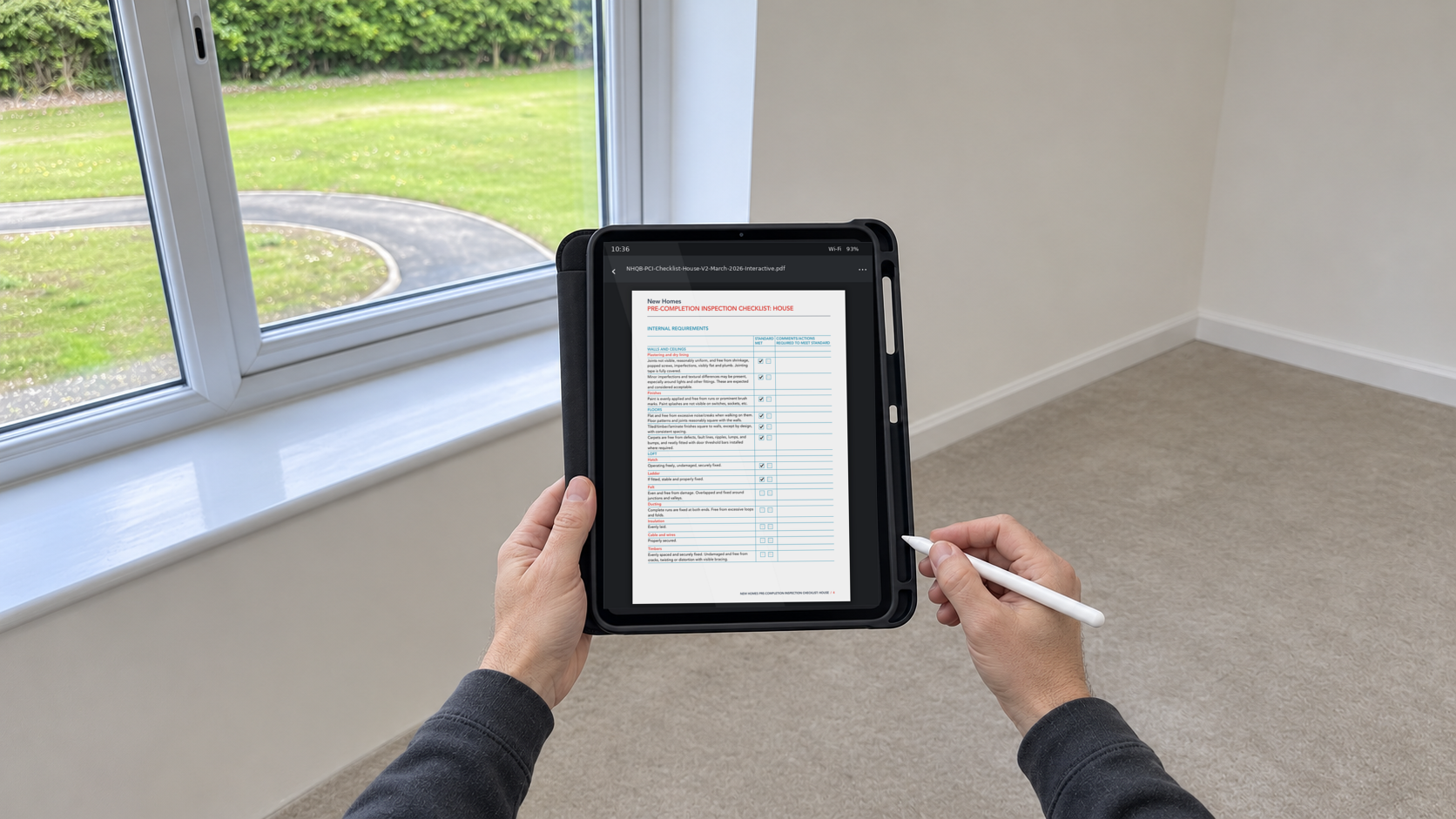
the prescribed NHQB Pre-Completion Inspection Checklist;
a photographic schedule of the defects identified;
clear comments explaining what requires attention;
your completed report within 24 hours;
a post inspection telephone call; and
ongoing support with questions arising from the report.
There is no payment upfront. Our fixed fee of £395 becomes payable once the inspection has been completed.
Received your inspection invitation?
“The property has already been snagged”
Your developer may tell you that the property has already been inspected or snagged by its own team. That internal inspection is important, but it is not independent and it is not undertaken specifically on your behalf. Even a conscientious site team can overlook defects.
They may be familiar with the property, working towards a completion deadline or concentrating on whether it is ready to hand over. An independent inspection provides a fresh assessment, objective measurements where required and photographic evidence of the property’s condition before you move in.
This is particularly important for damage to glazing, sanitaryware, worktops, flooring and decorative finishes, which can become harder to attribute once removals and furniture have entered the property.
Your developer’s inspection is not a substitute for independent advice.
Want to learn more?
Why were the NHQB and New Homes Quality Code introduced?
New home buyers have traditionally received a structural warranty, usually lasting ten years. Developers also operated under consumer codes that set expectations for selling, completing and dealing with problems in new homes. However, the system was fragmented. The protection available to a buyer and the route for resolving a dispute depended on which warranty provider or consumer code covered the developer.
Concerns were also being raised about build quality, customer service and the difficulty buyers faced when developers failed to resolve problems. A government consultation on housing redress found strong support for a dedicated New Homes Ombudsman. Of those who responded, 91% agreed that buyers should have access to an ombudsman and 84% supported a statutory scheme.
The New Homes Quality Board was launched in 2021 to strengthen consumer protection and improve standards across the new homes industry. It introduced the New Homes Quality Code and commissioned the independent New Homes Ombudsman Service. Older consumer codes have not disappeared. A home may still be covered by another code, depending on the developer and when the property was reserved.
What do the different names mean?
The three main names have different roles.
NHQB -The New Homes Quality Board is the independent organisation responsible for the Code and for overseeing the New Homes Ombudsman Service.
NHQC -The New Homes Quality Code contains the requirements that registered developers agree to follow.
NHOS -The New Homes Ombudsman Service provides buyers with a free and independent route for unresolved complaints against registered developers. The Code covers the buyer’s journey from reservation until two years after legal completion. It deals with sales information, contract matters, completion, the standard of the home, after-sales service and complaints.
Is my new home covered?
The New Homes Quality Code applies where:
the developer has active status on the NHQB Register of Developers; and
you reserved your home on or after that developer’s registration date.
You can check your developer using the NHQB Register of Developers.
If your purchase is not covered by the NHQB, it may fall under another consumer code. Block & Beam can check the applicable inspection process for you.
Why does the Code include a pre-completion inspection?
One of the protections introduced by the Code is the opportunity to inspect your new home before legal completion.
The developer must give you the opportunity to inspect the property yourself or appoint a suitably qualified inspector to complete the inspection on your behalf.
The purpose is to confirm whether the standard of finish is acceptable and to give both you and the developer a documented checklist of anything requiring attention.
The inspection normally takes place after notice to complete has been served and before legal completion, unless an earlier appointment is agreed.
Why use a suitably qualified inspector?
The NHQB checklist was designed to be used by someone who understands residential construction, relevant standards and acceptable tolerances.
The NHQB warns that an unqualified person may overlook or misinterpret requirements that the developer is expected to meet. Under the NHQB criteria, a professional inspector must:
hold relevant professional membership;
have appropriate professional indemnity insurance;
work within their professional competence; and
use the prescribed NHQB checklist.
Block & Beam meets these criteria and carries out the inspection independently on your behalf.
What does the inspection cover?
The inspection is non-invasive and covers the accessible internal and external elements included within the checklist. These include:
walls, ceilings, floors and decorative finishes;
windows, doors and glazing;
kitchens and fitted joinery;
plumbing, drainage and sanitary fittings;
heating, ventilation and electrical fittings;
brickwork, render, roofing and rainwater goods; and
paths, driveways, gardens and boundaries.
Suitable equipment may be used where the checklist specifies measurable standards for matters such as level, plumb, alignment, gaps or clearances.
How is it different from a post-completion snagging survey?
An NHQB Pre-Completion Inspection takes place before legal completion and must follow the prescribed NHQB checklist.
A post-completion snagging survey takes place after you have legally completed and received the keys. It may also identify faults that only become apparent once the home and its services have been used.
A pre-completion inspection cannot guarantee that no further issues will develop. It provides an independent record of the home’s visible condition before you move in.
Can my developer refuse the inspection?
A developer covered by the New Homes Quality Code must give you or your suitably qualified inspector the opportunity to complete the prescribed inspection. The developer can arrange the appointment, accompany the inspector and require reasonable health and safety precautions to be followed. The inspection is not intended to delay legal completion, but the developer must respond to valid findings in accordance with the Code.
What happens when problems are found?
The completed checklist and photographic schedule are provided to you for submission to your developer. Where an item does not meet the applicable warranty standards, it should ideally be corrected before legal completion. If that is not possible, the developer should explain when the work will be completed. Not every mark or imperfection will fall outside the relevant standards. Our report distinguishes between matters that meet the required standard and those requiring attention.
Official resources
Ready to arrange your inspection?
Tell us your developer, development, plot number and anticipated completion date. We will confirm the appropriate inspection process and help you arrange the next step.